

Passed in 2013, the Strategic Transportation Investments law (STI) establishes a framework and process for NCDOT to efficiently enhance the state's infrastructure, while supporting economic growth, job creation, and a higher quality of life. This process encourages thinking from a statewide and regional perspective while also providing flexibility to address local needs. STI also establishes the Strategic Mobility Formula to allocate available revenues based on data-driven scoring and local input.
The Strategic Mobility Formula is a transparent, systematic, and data-driven process for prioritizing the major transportation in the state and making investment decisions. Projects are evaluated based on an analysis of existing and future conditions, the benefits the project is expected to provide, and how the project fits in with local priorities. Each of the six modes of transportation (highway, ferry, rail, public transportation, bicycle & pedestrian, and aviation) use a data-driven approach for ranking projects, which are then combined with local input to determine which projects will be funded each cycle.
The outcome of the Strategic Prioritization of Transportation (SPOT) process serves as input to the Draft State Transportation Improvement Program (STIP). The STIP is then combined with locally-designated projects and input from the Triangle West TPO Board to create the Metropolitan Transportation Improvement Program (MTIP) for the TPO.
The tabs below on this web page provide further information on various stages of development of the FY2028-2037 STIP and TIP.
To find out more about Triangle West TPO projects, contact Filmon Fishastion.
The Strategic Prioritization Process, conducted by the Strategic Prioritization Office of Transportation (SPOT), is an essential part of developing the State Transportation Improvement Program (STIP). This transparent, data-driven process ensures that transportation projects which best aid North Carolina's development and mobility needs are prioritized for funding and implementation.
The SPOT process is currently in the 8th cycle. This process will allow the Triangle West TPO to submit up to 17 projects per mode (i.e. rail, transit, highway, and bicycle and pedestrian) into a competitive program that will fund projects across the state. These projects will then be added to the FY2028-2037 STIP. See below for the P8 schedule.
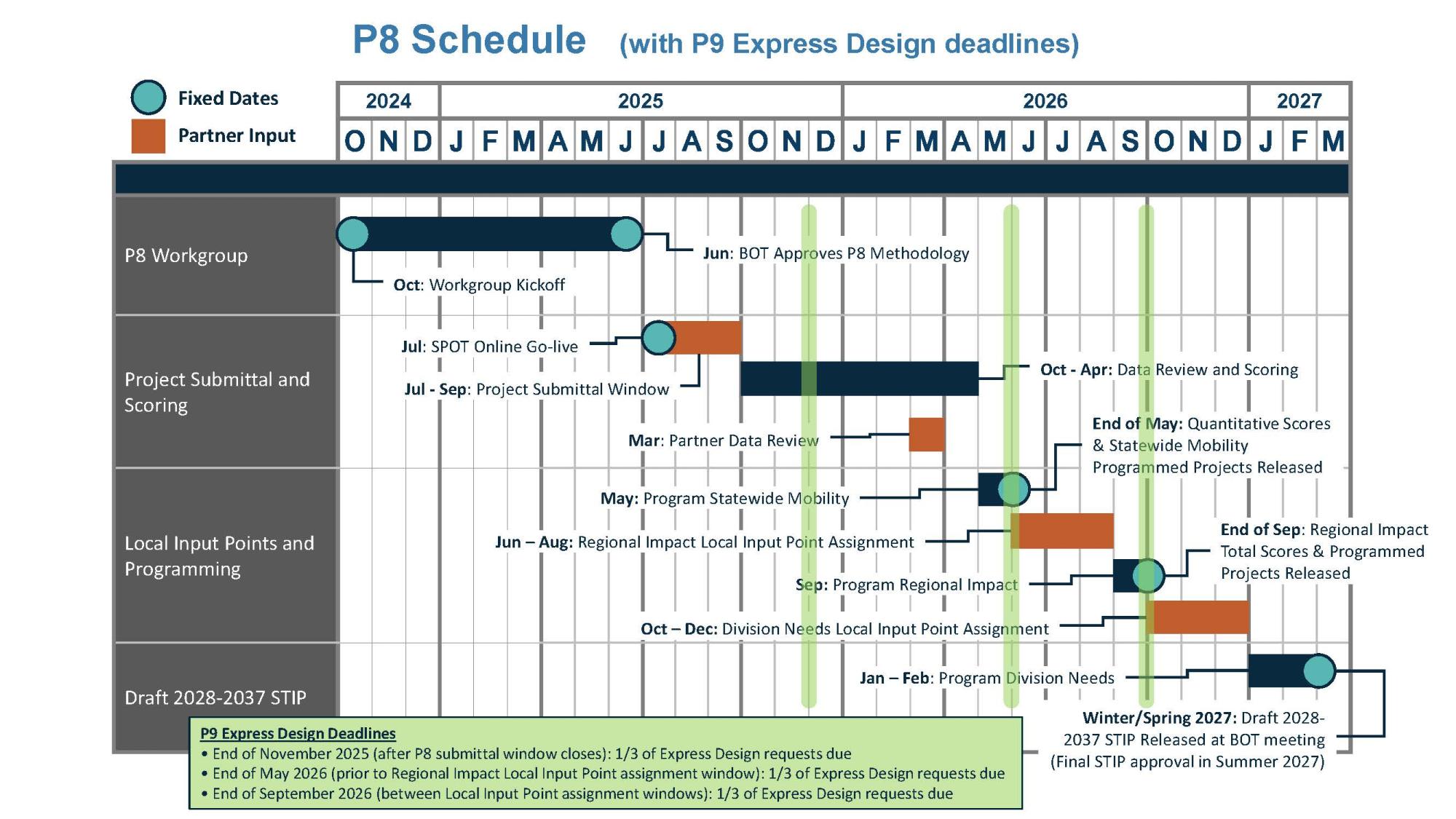
On April 22, 2025, the Triangle West TPO Board adopted the Triangle West Guidelines for Identifying New Transportation Improvement Program Project Requests for SPOT P8. These guidelines outline the TW TPO process for identifying and prioritizing transportation projects to be submitted for evaluation and funding under the Transportation Improvement Program (TIP). The TIP is a list of planned transportation projects that align with the region's long-term transportation plan and state funding priorities.
The main goal of these guidelines is to ensure that the projects selected meet the region's transportation needs, are cost-effective, and align with the goals of the Metropolitan Transportation Plan (MTP).
- Protect the human and natural environment and minimize climate change
- Ensure equity and participation
- Ensure that all people have access to multimodal and affordable transportation choices
- Promote safety, health, and well-being
- Improve infrastructure condition and resilience
- Manage congestion and system reliability
- Stimulate inclusive economic vitality
The process involves several steps:
Local Priority Lists: Local jurisdictions and agencies submit lists of priority projects. These projects are screened based on criteria like how well they meet regional goals, cost-effectiveness, and timing.
Project Consideration: The TPO compiles these lists with the Holding Tank list (projects that competed in P7 but were not awarded funding) to create a comprehensive list of projects that Triangle West is considering submitting to NCDOT. The TPO is limited to 17 project submissions for each mode and therefore cannot submit all projects being considered.
Project Selection: Following the public comment period, the TPO will work with the Technical Committee to narrow down the project list to the 17 submissions using the input provided by the public and other considerations such as the funding availability and local priorities.
Final Approval: The TPO Board reviews and approves the final list of projects to be submitted to the NCDOT. This happened at the September 23 meeting. See the projects that were approved below.
Once Triangle West and all other MPO’s, RPO’s, and Divisions have submitted their projects, NCDOT evaluates the projects using a scoring system to determine which ones will receive funding.
The projects approved at the September Board meeting will be evaluated alongside proposals from other MPOs and NCDOT Divisions statewide. This evaluation includes multiple rounds of data review.
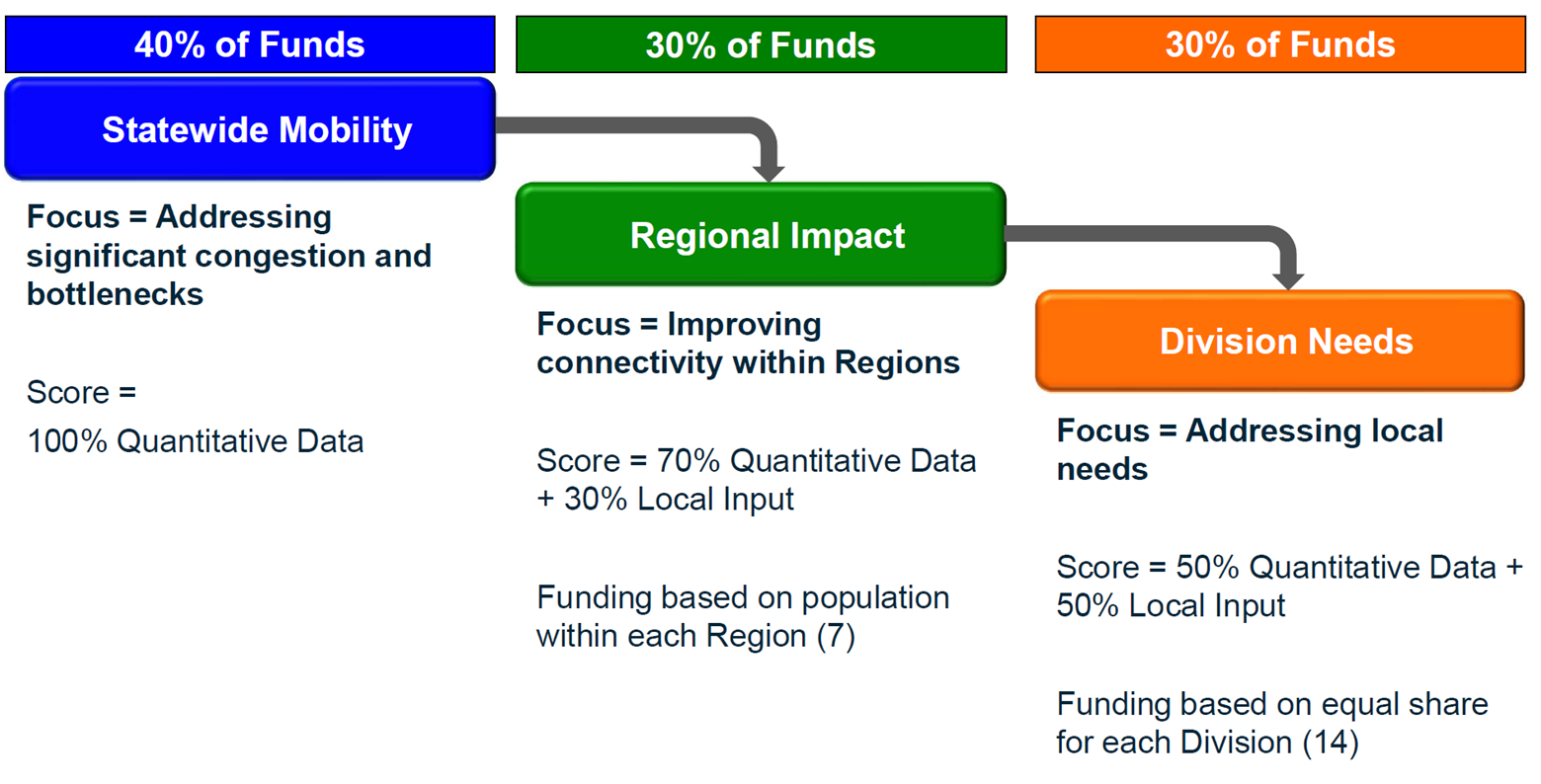
Throughout 2026, local input points will also be assigned. These points contribute to each project’s total score, supplementing the data-driven component according to the weighting shown in the graphic below. As indicated in the schedule above, the local input process will begin around mid-2026.
The Quantitative Scores have been released! They may be downloaded using the link below. Below is also a link to an online map of the projects.
Within the Strategic Prioritization Office of Transportation’s (SPOT) prioritization process, the Local Input Methodology outlines the procedure for identifying projects to be submitted to NCDOT for evaluation in addition to providing guidance on the allocation of input points to go towards projects within the Regional and Division categories of projects. The points are ultimately awarded based on the weights and criteria displayed on the table on pg. 15 of the Local Input Point Methodology below that was adopted at the March 2026 Board Meeting.
The Triangle West TPO has reached the public feedback stage of the Strategic Prioritization process. At this stage, the TPO releases the preliminary allocation of Local Input Points and invites the public to review and comment on it before the points are finalized.
As explained in the Project Scoring section above, Local Input Points are assigned by the TPO and added to each project’s quantitative (data-driven) score. Together, the quantitative score and the local input points make up a project’s total score, which NCDOT uses to decide whether a project is selected for funding. Because these points can have a real effect on which Regional Impact and Division Needs projects move forward, we want to hear from residents, community members, and partner agencies before the allocation is finalized.
What We Are Asking You to Review
The TPO has prepared a preliminary assignment of Local Input Points across the Regional Impact and Division Needs project categories. This assignment reflects the weights and criteria in the adopted Local Input Point Methodology, along with regional priorities and funding availability. You can review the full preliminary point assignment using the link below.
How to Share Your Feedback
We encourage you to review the preliminary point assignment and let us know whether it reflects your community’s transportation priorities. You can submit your comments in any of the ways listed below.
- Complete our online comment survey
- Email your comments to: publiccomment@twtpo.org
Public Comment Period
The public comment period is open from June 25 through July 26. All comments received by the closing date will be reviewed by TPO staff and the Technical Committee.
What Happens Next
After the comment period closes, the TPO will compile and review all feedback received alongside other considerations such as funding availability and local priorities. Based on this review, staff and the Technical Committee may adjust the preliminary point allocation. The finalized Local Input Point assignment will then be presented to the TPO Board for adoption. Once adopted, the local input points are combined with the quantitative scores to produce each project’s final score, which NCDOT uses to determine funding.
Below is a list of the helpful links that are referenced on this page.