
The Strategic Regional Rail Infrastructure Study was a joint project led by the Capital Area Metropolitan Planning Organization (CAMPO) and the Triangle West Transportation Planning Organization (TWTPO). It explored how the Triangle region can grow passenger rail service between key communities and connect to the broader Southeast rail network.
This work builds on ongoing efforts by NCDOT Rail and the Federal Railroad Administration (FRA) to link Raleigh, Durham, Cary, and nearby cities to that larger network. The study reviewed current and future rail projects, matched them with potential funding sources, and outlined a path toward improved regional passenger and freight rail.

The study team set out to:
- Identify realistic rail corridors for future passenger service
- Assess each corridor's ability to attract state and federal funding
- Create a framework to help local leaders prioritize rail investments
Offer a roadmap for near-term improvements that communities can fund locally
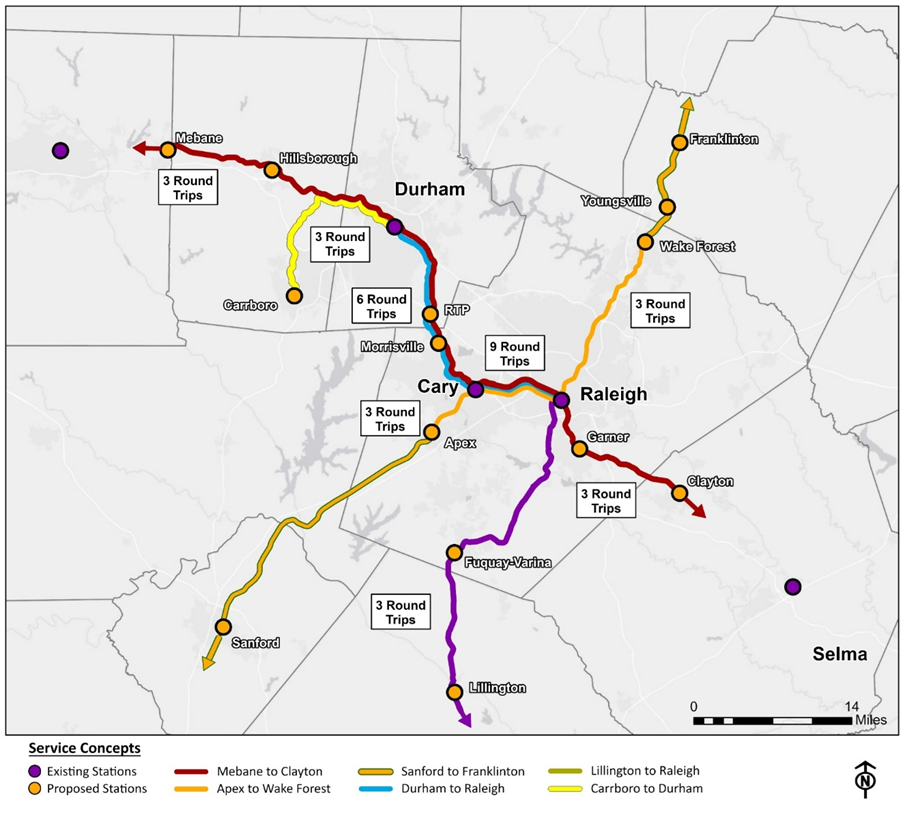
The image below displays the Service Concepts that were proposed for the region. Each Service Concept identifies two endpoints for the rail service and assumptions about a service pattern. For each Service Concept, the study team assumed 3 trains per day in each direction.
The study developed a set of guiding principles to help local leaders understand the challenges and opportunities in building a regional rail network:
| Principle | What It Means |
|---|---|
| Federal Perspective | The FRA focuses on connecting regions, not just individual cities |
| Freight Rail Partnerships | Freight railroads like Norfolk Southern and CSX must be willing partners for new routes to move forward |
| State Priorities | NCDOT Rail favors corridors that already have agreements or federal grants in place |
| Funding Alignment | State scoring systems reward upgrades to existing lines and improvements to rail crossings |
| Funding Climate | Federal grant priorities shift over time — projects with clear, multi-region benefits are most competitive |
Even when state and federal funding isn't available, communities can take smaller, targeted steps on their own. The study recommends this order of local investments:
- Eliminate dangerous rail crossings to improve safety
- Advance station design early to make projects ready for construction
- Protect land for rail yards and maintenance facilities
- Improve track connections to reduce congestion
- Study ridership potential to identify where to expand first
- Invest in the NC Line to support both passenger and freight growth
Q: When will new train services start?
A: This is a planning study, not a construction plan. It maps a clear path forward. Actual service depends on securing significant funding and completing detailed engineering work.
Q: Will this plan take people's property?
A: No. This study does not identify specific tracks or properties for acquisition. Any future project would go through its own separate public review process.
Q: What is the most important takeaway?
A: The Triangle region now has a shared, strategic plan. We know which routes are most promising and how to work with state and federal partners to make progress.
Q: What are the next steps?
A: This study is the first step. Future work will include focused follow-up studies, refined priorities, and competitive grant applications to move from planning to real projects.
Below are the final deliverables that were produced from the study.
For more information please contact:
Filmon Fishastion - Transportation Planner